
ViewX is LIVE on Kickstarter View On Kickstarter
Listen Up! Esport Store Owners

I’ve been watching the gaming monitor market closely, and the numbers are staggering.
Global gaming monitor shipments hit 41 million units in 2025 — up 50.2% year-on-year, accounting for 31.1% of all desktop monitor shipments. OLED gaming monitors alone saw shipments jump 84% on high-end gaming demand.
The Middle East gaming market? Estimated at $7.04 billion in 2025, projected to reach $11.87 billion by 2030 at an 11.02% CAGR. Saudi Arabia alone accounts for 57.6% of the MENA gaming market.
But here’s the challenge for gaming distributors and retailers:
Everyone is selling the same story. 240Hz. 4K. 0.1ms response time. OLED vs. QD-OLED.
When every distributor carries the same spec sheets, these become table stakes — not differentiators.
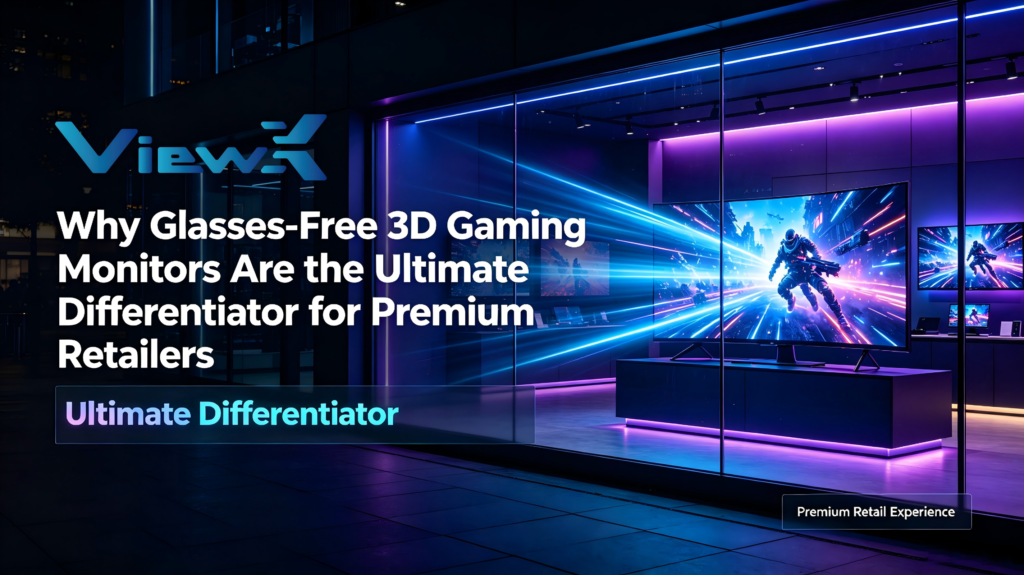
Premium gaming retailers are increasingly turning to immersive branded environments to stand out. Corsair and Razer are both pushing immersive retail stores designed to showcase complete gaming ecosystems rather than individual products.
So what actually makes people stop, look, and remember a store?
The Answer: A Category No One Else Owns
Glasses-free 3D gaming monitors offer something no competitor can replicate — a visual experience that must be seen to be believed.
The global glasses-free 3D display market is projected to grow from $1.4 billion in 2025 to $4.5 billion by 2035 at a 12.3% CAGR. The glasses-free 3D gaming monitor segment alone reached approximately 300,000 units in global sales in 2024, with an average market price of around $1,612.
Here’s why this matters for distributors and retailers:
1. It Creates a “Wow” Moment That Drives Foot Traffic
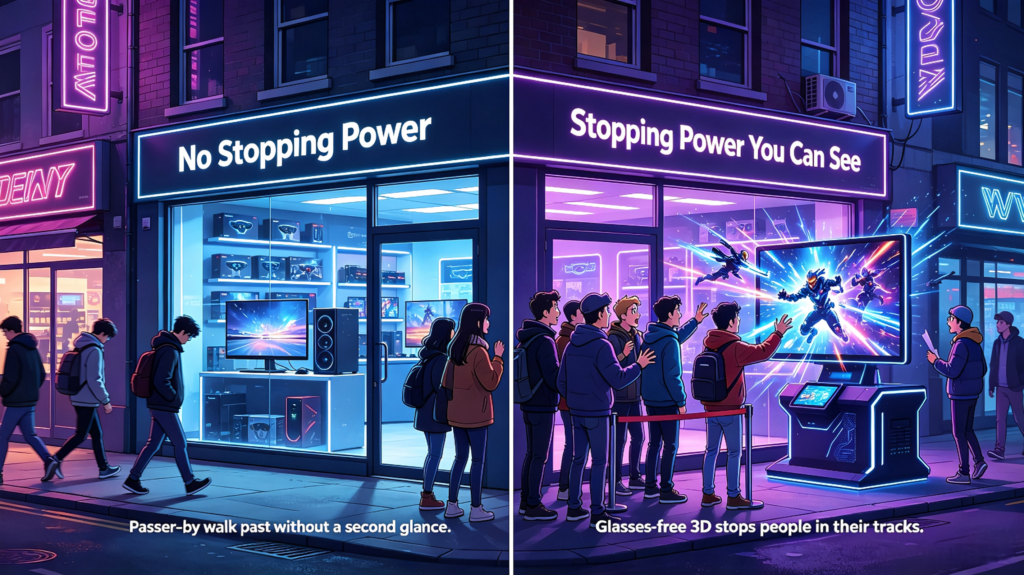
Glasses-free 3D is not a spec — it’s an experience. When a customer sees 3D depth emerging from a screen without wearing any glasses, that moment of surprise is exactly what premium retailers need to turn window-shoppers into buyers. In-store demonstration is not a nice-to-have — it’s the core of the go-to-market strategy.
2. It Gives Retailers a Category No One Else Owns
While competitors fight over OLED vs. QD-OLED, refresh rates, and response times, you can offer something entirely new — a display that delivers true spatial depth without headsets or glasses. In a premium retail environment where differentiation is everything, owning a category is the ultimate competitive advantage.
3. It Attracts the Early Adopter and Premium Spender
The average 3D gaming monitor sells for around $1,612. This price point naturally filters for customers who are willing to spend on cutting-edge technology — exactly the demographic premium retailers want to attract. These are the customers who buy ecosystems, not just individual products.
4. It’s Compatible with Everything Gamers Already Own
It works with laptops, smartphones, PS5, Nintendo Switch, ROG handhelds, and desktop PCs — meaning customers don’t need to buy into a new ecosystem. It’s a plug-and-play upgrade to their existing setup, lowering the barrier to purchase.
5. 3D Games Are Already a Dominant Force in the Gaming PC Market
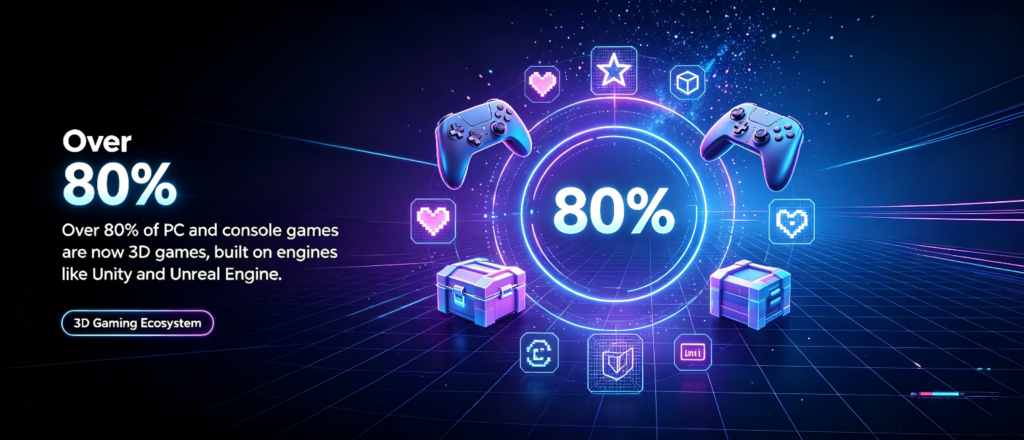
This is perhaps the most overlooked advantage: the content is already there. Unlike VR headsets that require developers to build content specifically for a closed ecosystem, our glasses-free 3D display works with existing 3D games. And here’s the key number — over 80% of PC and console games are now 3D games, built on engines like Unity and Unreal Engine. Even on mobile, the hottest titles are 3D. This means your customers don’t need to wait for a new content library to be built; they can experience the 3D effect immediately with the games they already own and love. For a distributor, this removes the single biggest barrier to adoption: content availability.
Why This Matters for Distributors Right Now
The Middle East presents a particularly compelling opportunity:
Young, tech-hungry population: Around 70% of Saudi Arabia’s population is under 30, with approximately 20 million gamers or gaming enthusiasts
Massive esports investment: Saudi Arabia has committed $38 billion to secure its status as a global esports hub
Premium spending behavior: The average gamer in the UAE spends $115 per year on gaming
Fastest-growing region: The Middle East is expected to post the fastest gaming market growth at a 12.9% CAGR
For gaming distributors and retailers across the UAE, Saudi Arabia, and beyond, glasses-free 3D gaming monitors represent a tangible, demonstrable point of difference in an increasingly crowded premium gaming retail landscape.
The Retailer’s Playbook
If you’re a gaming distributor or retailer considering this product, here’s how to make it work:
Set up a dedicated demo station — Let customers experience the 3D effect firsthand. This is non-negotiable.
Train sales staff to demonstrate the “wow” — Your team should be able to articulate the technology simply and show the effect in seconds.
Bundle with premium gaming setups — Position it as the centerpiece of a high-end gaming rig, not just another monitor.
Leverage the exclusivity — In a market where every retailer has the same OLED panels, being the first to offer glasses-free 3D creates genuine buzz.
The Bottom Line
Premium gaming retailers don’t win by selling what everyone else sells. They win by offering experiences customers can’t get anywhere else.
Glasses-free 3D gaming monitors are not just another SKU — they are a category-defining product that creates foot traffic, drives premium sales, and positions your store as the destination for cutting-edge gaming technology.
In a market where differentiation is everything, glasses-free 3D is the ultimate differentiator.
If you’re a gaming distributor or retailer looking to differentiate your offering, please email me @ ling.zhong@viewx3d.com. I’d love to share more about how we’re bringing glasses-free 3D to the market.